
Today, Aviator leaves the hangar door open.
This is our first proper devlog about the project: an airline strategy prototype with a fondness for big maps, ambitious timetables, and the sort of financial decisions that look perfectly sensible right up until the quarterly report arrives.
The pitch, with the windows down
Aviator is set in the grand, optimistic era of commercial flight. You start small — one airline, one home city, one starting trait — then begin stitching the world together route by route. The fantasy is not just owning aircraft. It’s looking at a city and thinking: “There should be a flight between here and there.” Then having the nerve to try it.
We’re also designing toward local multiplayer. The long-term hope is for Aviator to feel like a classic board game made easier by digital tools: everyone at the same table, with a smart moderator handling the fiddly work, clarifying the rules, and keeping the focus on the plans and surprises that make a session memorable. That part is still a roadmap ambition, but it is already shaping the way we think about the game.
The current prototype already has the bones of that fantasy:
- City opportunities weigh available slots, slot prices, growth, business demand, and tourism demand.
- Rivals are generated with distinct identities, colours, home regions, and strategy profiles, so the competition has a little more personality than “blue airline” and “other blue airline.”
- The aircraft market covers historical models from regional props through short-haul jets, medium- and long-haul aircraft, and jumbos.
- Each save gets its own aircraft timeline. A model may arrive a few years early or late, then age, become obsolete, and eventually retire — because even the most glamorous machine cannot negotiate with the calendar.
- Quarterly statistics track passengers, revenue, profit, route age, regional performance, and world rankings.
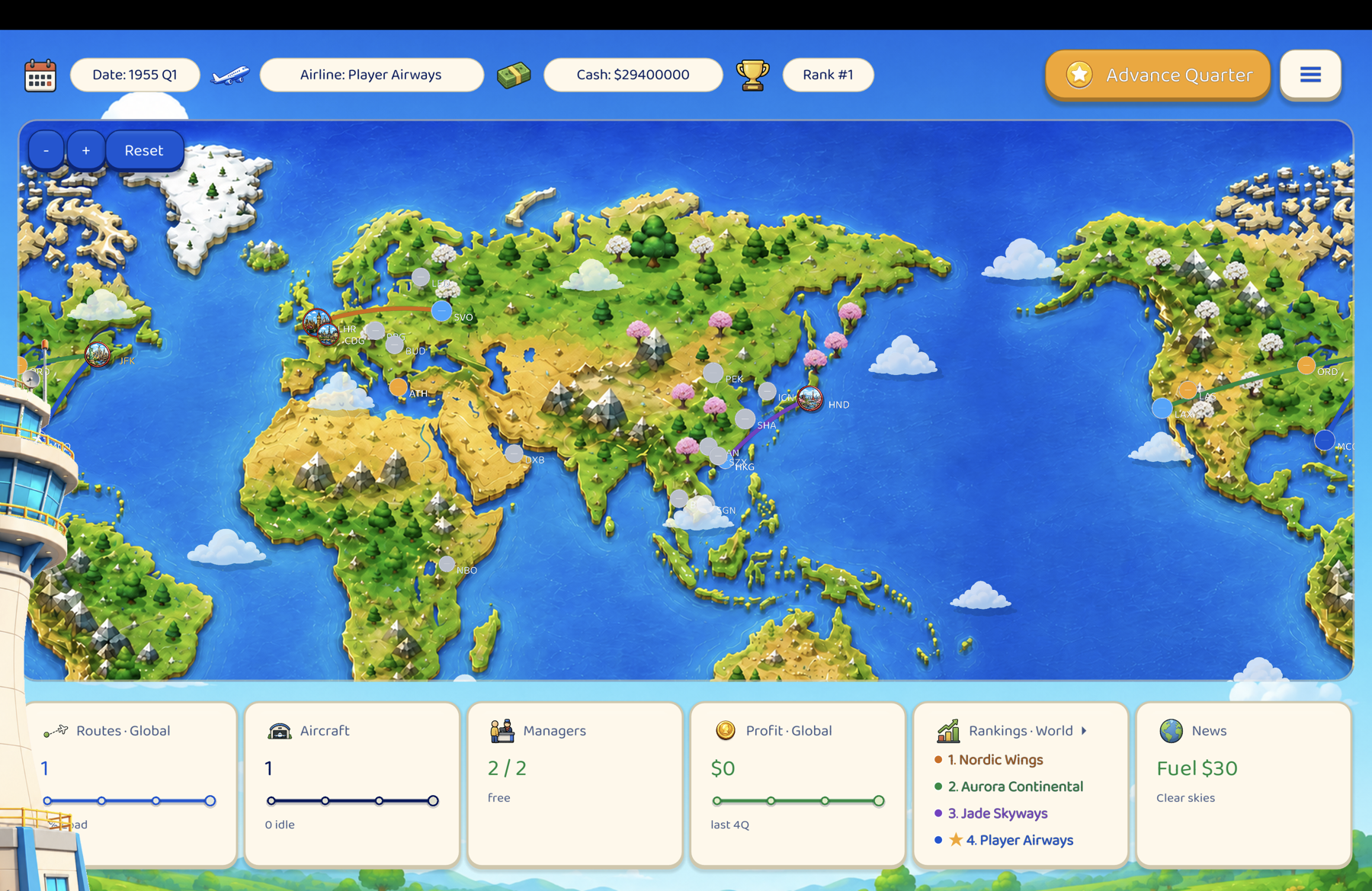
The first screenshot is the world map in an early build: a bright, toy-box view of the globe with routes beginning to criss-cross between cities, while the top bar keeps a close eye on cash, rank, airline identity, and the next quarter. It’s the strategic view — the part where a promising line on the map starts asking very practical questions.
The second screenshot moves into the aircraft hangar. Here, the market presents a small parade of historical machines, each with its own range, capacity, fuel efficiency, maintenance cost, reliability, and comfort. The fleet is still wonderfully provisional — these are early builds, with the numbers and presentation continuing to evolve — but the intention is clear: choosing an aircraft should feel like choosing a character for the next act.
The fun bit
What we like most so far is the tension between the romantic and the practical. A shiny new aircraft can open a glamorous possibility, but fuel, maintenance, reliability, and route demand are waiting just outside the spotlight. A rival may be sitting on a healthy cash pile. Oil prices may have opinions. A route can be brilliant in theory and still require a bit of convincing in practice.
That balance — the dream of flight with the paperwork still attached — is the heart of Aviator. We want each quarter to offer a neat little story: a promising route, a fleet decision, a rival making an entrance, an unexpected turn in the market. In a shared session, those moments should give people something to debate, celebrate, grumble about, and preferably one decision that makes everyone lean back and say, “Oh, that was clever.”
Next from the flight deck
We’re continuing to tune the economy, improve the management dashboard, and test how the generated airlines behave over a full scenario. We’re also thinking through the moderator experience: which rules should be explained, which tasks should disappear into the background, and how to keep a local session moving without taking away the pleasure of figuring things out.
There’s plenty more atmosphere to add around the systems, too: more event flavour, more ways for the map to feel alive, and more moments where your airline feels like your airline.
For now, the engines are warm, the route board is full of possibilities, and someone has definitely misplaced the fuel forecast.